Building Regulations for Windows and Doors: What Homeowners Need to Know
21st May 2026
When replacing windows or doors, most homeowners focus on style, colour, security and energy efficiency. While those things are all important, there is another key factor that should never be overlooked: Building Regulations.
Full Guide - Buidling Regs Windows and Doors (WEB0526)
Windows and doors affect far more than the look of your home. They play a major role in heat retention, ventilation, fire safety, accessibility, security and everyday comfort. Because of this, replacement windows and doors must be specified and installed correctly to meet the required standards.
Here is a practical guide to the main Building Regulations that apply to residential windows and doors, and why they matter.
Why Building Regulations Matter
Building Regulations are designed to make sure homes are safe, efficient and suitable to live in. For windows and doors, this means looking at how products perform as part of the whole property.
A window is not just a pane of glass. A front door is not just an entrance point. Both have to contribute to the way the home works day to day, including:
- Reducing heat loss
- Allowing suitable ventilation
- Providing safe escape routes
- Reducing the risk of injury from glazing
- Improving security
- Supporting accessibility
- Helping manage overheating in newer properties
If work does not meet the required standards, it may be rejected by Building Control and could need to be corrected or redone. That is why it is important to use experienced installers who understand both the product and the regulations behind it.
Fire Safety: Part B
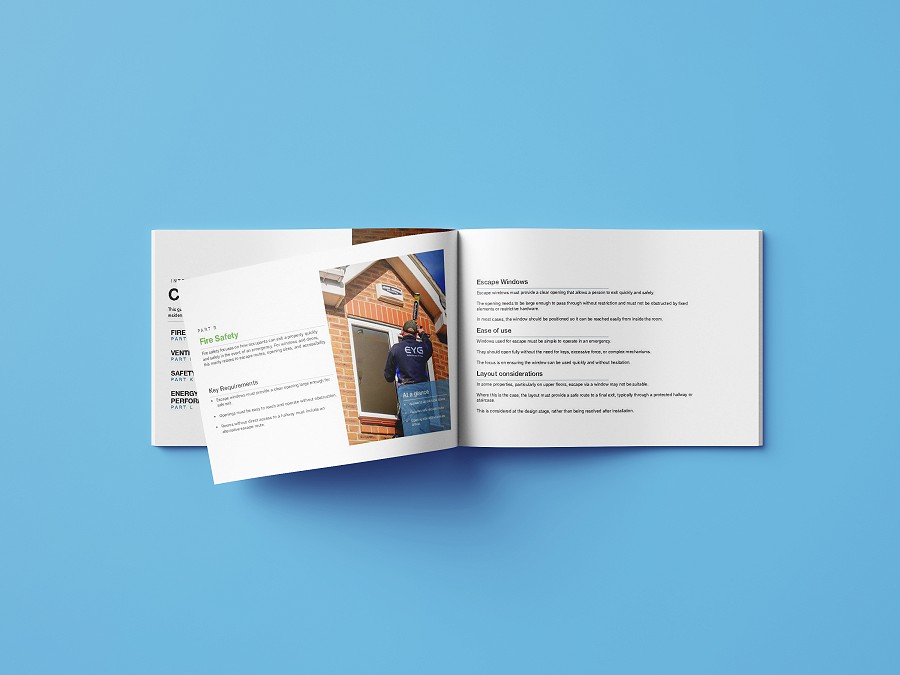
Fire safety is one of the most important considerations when replacing windows and doors. In many homes, certain windows may need to act as emergency escape routes.
This is particularly important in habitable rooms, such as bedrooms and living spaces. Escape windows must provide a clear opening large enough for a person to exit safely in an emergency. They should also be easy to reach and simple to operate, without the need for keys, complicated mechanisms or excessive force.
In some properties, particularly on upper floors, escape through a window may not be the safest or most practical option. In these cases, the overall layout of the property must provide a suitable route to a final exit, usually through a protected hallway or staircase.
This is why fire safety should be considered before installation, not treated as an afterthought.
Ventilation: Part F
Modern windows and doors are designed to be much more efficient than older products. While this helps reduce draughts and heat loss, it also means ventilation needs to be properly considered.
Part F focuses on airflow within the home. It helps make sure properties have enough ventilation to control moisture, remove stale air and maintain a healthy indoor environment.
For windows, this often means including background ventilation through trickle vents or similar systems. These allow a steady flow of fresh air into the home, even when the windows are closed.
Homes also need rapid, or purge, ventilation. This is usually achieved through openable windows or doors, allowing stale or humid air to be cleared quickly when needed.
Ventilation is especially important in areas such as kitchens and bathrooms, where everyday activities like cooking, showering and washing create higher moisture levels. Without adequate ventilation, condensation can build up on windows and surrounding surfaces, increasing the risk of mould and long-term damage.
Safety Glazing: Part K
Not all glass in a home carries the same level of risk. Some areas are more likely to be impacted during normal use, such as doors, low-level glazing and panes close to walkways.
Part K deals with safety glazing in these critical locations. Where glass is positioned in an area where someone could fall into it, walk into it or accidentally strike it, safety glass is usually required.
This may include toughened glass, which is designed to break into smaller, less harmful pieces, or laminated glass, which holds together when broken and helps maintain a barrier.
Typical areas where safety glazing may be required include:
- Glass within doors
- Full-height glazing
- Low-level windows
- Glazing close to doorways
- Large panes in busy areas of the home
The size, position and use of the glazing all affect what level of protection is needed.
Energy Performance: Part L
Energy efficiency is one of the biggest reasons homeowners choose to replace their windows and doors. Part L focuses on reducing heat loss and improving the overall thermal performance of the property.
Windows and doors are measured using U-values. A U-value shows how much heat passes through a material. The lower the U-value, the better the insulation.
However, performance is not just about the glass. The frame material, glazing unit, seals, spacers and overall construction all contribute to how efficient the product is.
Poorly performing windows and doors can lead to cold spots, higher heating demand and inconsistent room temperatures. Even small inefficiencies can add up across a whole property, especially in homes with multiple windows or large glazed areas.
Choosing well-specified products and having them installed correctly helps improve comfort while supporting better energy performance.
Overheating: Part O
While energy efficiency is often associated with keeping heat inside during colder months, modern homes also need to manage excess heat during warmer weather.
Part O applies mainly to new dwellings and looks at the risk of overheating. This is particularly relevant where large areas of glazing are used, or where rooms face south or west and receive strong sunlight.
Glazing can allow solar heat to enter a room quickly. If that heat cannot escape, the space can become uncomfortable.
Managing overheating may involve looking at:
- The size and position of windows
- The orientation of the property
- The type of glazing used
- Shading
- Ventilation
- How air can move through the home
Openable windows play an important role by allowing warm air to escape and helping regulate internal temperatures.
Accessibility: Part M
Windows and doors should not only meet technical standards; they should also be practical and easy to use.
Part M focuses on accessibility, particularly around entrance doors, thresholds, opening widths and ease of operation.
For doors, this can include providing level or low-threshold access where possible. This makes everyday movement easier, not just for wheelchair users, but also for families with pushchairs, people carrying shopping, deliveries and general day-to-day use.
Door openings should be wide enough to allow comfortable access, and handles, locks and controls should be easy to reach and operate.
A product may look good on paper, but if it is awkward to use every day, it can quickly become frustrating. Good design considers both compliance and real-life usability.
Security: Part Q
Security is another key part of Building Regulations, particularly for windows and doors that could be vulnerable to forced entry.
Part Q focuses on making sure doors and windows provide an appropriate level of protection based on their location and use.
This includes more than just fitting a strong lock. Security depends on the complete system working together, including:
- Locking mechanisms
- Hinges
- Frames
- Glazing
- Hardware
- Installation quality
Multi-point locking systems are commonly used because they secure a door or window at several points along the frame. Laminated glass and reinforced frames can also improve resistance against attempted forced entry.
However, even a good product can underperform if it is poorly fitted. Gaps, weak fixings or badly aligned hardware can reduce security in practice, which is why correct installation is just as important as product choice.
Why Installation Standards Matter
Building Regulations set the standard, but meeting that standard depends on proper specification and installation.
A window or door has to work as part of the whole property. It needs to retain heat, allow ventilation, provide security, support safe escape where required and remain practical for everyday use.
Focusing on one feature alone is not enough. For example, a highly insulated window still needs suitable ventilation. A secure door still needs to be usable. Large glazed areas need to balance natural light with overheating control.
That is where experience matters.
Choosing the Right Windows and Doors
When choosing replacement windows and doors, it is worth asking more than just “what does it look like?” or “how much does it cost?”
You should also consider:
- Does it meet current Building Regulations?
- Is the glazing suitable for its location?
- Will the room still have enough ventilation?
- Are escape requirements being maintained?
- How energy efficient is the full window or door, not just the glass?
- Is the product secure as a complete system?
- Will it be practical and easy to use every day?
- Is the installation being carried out by experienced professionals?
Getting these details right helps protect your home, improve comfort and reduce the risk of problems later.
Designed to Perform. Installed to Last.
Windows and doors are a major part of how your home performs. They affect warmth, airflow, safety, security and everyday usability.
Building Regulations are there to make sure those standards are met, but the right outcome depends on choosing suitable products and having them installed correctly.
At EYG, we understand that every home is different. Our team can help you choose windows and doors that not only look right, but are designed to perform properly for years to come.
Thinking about replacing your windows or doors? Contact EYG today or visit your local showroom to speak to our team.